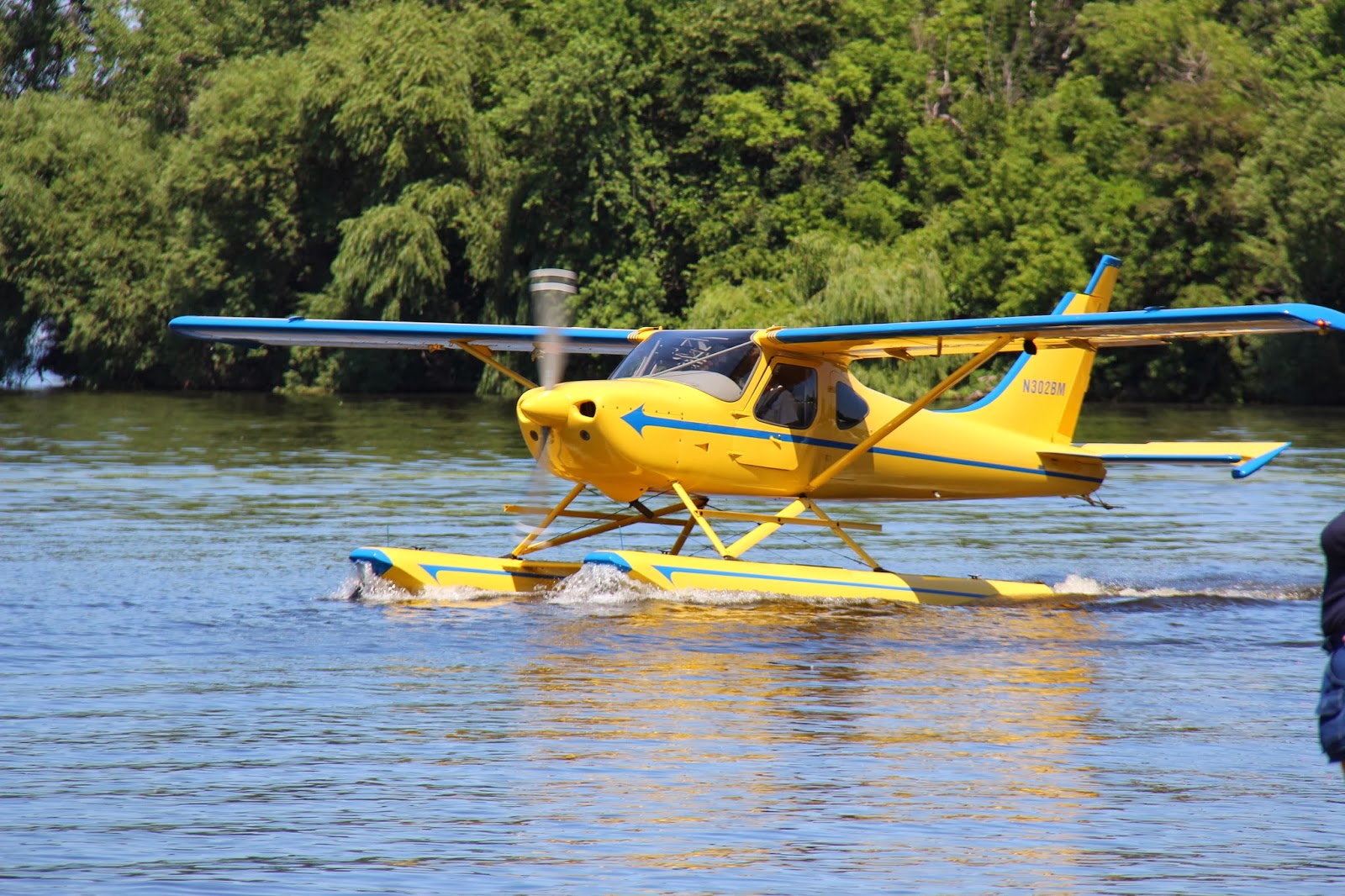
This is the story of my first airplane; a 2007 Glasair Sportsman. My dream of owning a plane finally came true on June 1st, 2009, when I flew this wonderful bird from Asheville, NC to NY. This is my story.

Friday, September 6, 2013

Service Bulletin No. 70

When I first bought N9GZ from the John Mark Stroud back in '09, I noticed some small cracking at the base of the vertical fin. These cracks seemed to be a paint issue but I followed up with John and he provided some email correspondence from the factory on their take on the issue. Their view was quote "Nothing I see gives me a concern for structural integrity since the vertical fin structure relies primarily on the vertical fin spar and secure attachment to the fin trailing edges and bulkhead C. The cracks are surface in nature, stemming from flexing or expansion of the adhesive joint on the right half of the vertical fin."


So I kind of forgot about it since there wasn't any structural problems with the plane. Over the next two years or so, the crack grew slightly and if anything,  I was starting to let this small blemish on an otherwise nice paint job start to bother me. I knew that I had to get this fixed one day but I kept putting it off. I was worried about matching the color and wondering who could I trust with painting the plane. Then I started reading of some other owners who had similar cracks and thought maybe there's something more going on here. It wasn't long before Glasair released Service Bulletin No. 70.

The you read through the bulletin, you'll see what amounts to the issues and the fix. It involves sanding down the area and also installing a reinforcement piece to the vertical spar at bulkhead C. I ordered the part for the spar and had Joe at A&P do the install. Thankfully there were no deep cracks and everything pointed to just some cosmetic cracking. However, now I had to see who could paint the plane to match the original color. Well, the closest guy also happens to be the best around, Ed's Aircraft Refinishing over at Brookhaven airport. The problem was getting an appointment.

Eventually, Ed found time for me and did a great job adding the additional composite to the area and matching the paint.


So for now, all good.

Monday, March 18, 2013

Landing Lights revisited... LED

As you may have seen in my earlier post I changed out the standard halogen MR16 landing lights for HID lights a few years ago and really liked the improvement in brightness and range of the high intensity lights.  Because of their size, there weren't too many options available and I wanted the brightest I could find. I decided on a pair from Rigid Industries and Joe at A&P did a great good installing them. However, they were not without their problems. The main issue was that I rarely could get both of my lights to come on at the same time. Sometimes, if I cycled the switch it would work but it was hit or miss. After hours of tinkering with it for months, switching parts and calling the manufacture, I just gave up and started to look for a replacement. (I see Rigid doesn't even sell them anymore..) Now there are others out there but I was starting to see if I could find an LED MR16 replacement. Well, so began my long road to make something work.

Now there are a number of MR16 LED's for home use, but there are two issues; brightness and noise. I ordered a number of sample units to see if they would work and quickly found out that anything less than 1000 lumens was not going to work for a landing light. Plus the cheap home improvement store ones would completely interfere with my radios. I wanted as bight of a LED as I could get so I was sure someone out there had done something for the experimental market. Well, none of the Glastar Sporteman owners had a solution but a guy with a Van's RV had. He did a lot of work trying different lights and ended up with a LED CREE flashlight unit that would fit the MR16 mount in the wingtip of his plane! There had to be a few modifications but it would fit in the MR16 housing. The unit was rated for 9-12v and 2000 lumens and sold for about $30! This was great!


So I ordered a few from China and waited 4 weeks for them to come in. (ugh..) I also decided to do something else I couldn't do with the HID's; have the lights pulse or wig-wag for added safety. I looked around for a number of options and decided on a simple solid state unit from this guy. The unit is small and the wiring is easy.


 Mounting the lights and wiring them up was not that big of a deal. I originally wanted to have a three way rocker installed to replace my original light switch but that proved undoable, so I decided to add an additional switch for the wig-wag function. I was amazed how bright they were.


Seems like I'm all set right? Nothing is that easy. With everything installed I went out for my first flight and returned only to find the lights had failed! What had happened? Now these lights will get hot and anyone who owns one the these flashlights know that they can't stay on continuously at high output for very long. They do have a safety feature that will shut down the light to cool off and will cycle back on, but I was certain that with the lights located in the cowl and continuous airflow from the prop there would not be any heat issue. The only other reason I could think of was vibration. Sure enough when we removed the light you could hear something rattling inside. In fact vibration is a problem for any light in the cowl. Since the guy with the RV had his in the wing, vibration was not an issue. I was going to have to find a solution. Through some trail and error and a few different arrangement, Joe was able to open up the LED housing, isolate the offending part and attach it outside the housing with some additional wiring.


If you look close you can see the circuit board is now outside of the cowl light tube and insulated from any vibration. The wiring inside the LED was cheap also so we improved that. After a check on the ground I went flying and everything worked! I have flown with the wig-wag on all the time without any failures. I really can't thank Joe enough for coming up with this solution.


Monday, August 6, 2012

AirVenture 2012

I made it to Oshkosh again this year and as always enjoyed the few days I was there. It's fun making the long cross country flight and the Sportsman is a great plane for the trip. The weather was broken at around 1200 feet at Islip so I filed IFR to get out and was VFR within 20 minutes heading west. As usual I made one stop in Pennsylvania and another in Indiana before making my final stop in Watertown, Wisconsin.  There was some weather in the area but things were slowly improving as the day wore on.

Each year when I plan my trip I try to make it with the Glastar Sportsman owners who organize a mass fly in on the Sunday before the show starts. It's great fun and we leave early in the morning to avoid the rush. The other benefit of Sunday is that there is no air show that closes the airport, something that happens each day during the week of the show. I wasn't able to meet up with them this year but did take advantage arriving Sunday only later in the day. Here's my arrival:


For the first time I arrived on runway 27 which was fun.  Except for the Skyhawk who cut right in front of me then took it out over the gravel pit, which was a no no, I had no issues flying in (a lot different the last year!) I had a slight over shoot on my turn to final but made a pretty good landing.  I was thrilled to be there again!


I did have one surprise that I wasn't counting on. When some rain came through a day or two later and I decided to put my cover on and noticed a problem with my exhaust mount. One of the wires that secure the tuned exhaust under the cowl had failed.


 I don't know when it happened but I knew I couldn't leave until I got it fixed. Well, I had no tools or parts but heck, I was at EAA AirVenture! Turns out that EAA has is a group of Volunteers who have been staffing an emergency aircraft repair barn for a number of years. EAA has a great video of the people who run the booth. The people there were just great. The had the wire and crimping tool to make a new part and within a few hours it was good as new. Thanks EAA!

AirVenture was HOT this year. The midwest was in the mist of a drought and the grounds were dry and scorching! Thank God for having a high wing aircraft!


So this year was the 75th anniversary of the Piper Cub and there were about 75 cubs that flew in. It was a great sight seeing mostly yellow cubs all parked in the same spot. The first RV was also restored and did a fly buy. There was as usual so many planes to see. Here's a sampling of the planes I enjoyed the most.


75th Anniversary Cubs


Van's RV-1 


There was one plane that I saw this year which meant a great deal to me. I graduated from the University of Michigan in 1980 with a degree in Aerospace Engineering and I was fortunate enough to take an aircraft design course from Professor Edgar J. Lesher, a hall of fame designer and builder who held quite a few FAI records in the C-1a class. It was a privilege to take the class from such an esteemed professor and I remember seeing pictures of his Lesher "Teal" at the University. So imagine may delight when I saw his plane being displayed with other historic homebuilts. I couldn't believe the plane from my professor was right there in front of me. I'm sure most people just walked by it but for me, that was some special plane. Sure brought back lots of memories.


Always enjoy AirVenture, even as hot as it was.

Thursday, April 12, 2012

Tailwheel Shimmy

So anyone who owns or flies a tailwheel aircraft will at some point run across the annoying tailwheel shimmy. I have never run into a pilot who hasn't had that dreaded vibration that occurs during landings. Whenever I meet an owner with a conventional gear I always ask how often he gets the shimmy and what he has done to prevent them from happening. The Sportsman is no exception.

When I converted my plane to a tailwheel, I was still an inexperienced tailwheel pilot but never had any real issue with the tailwheel. But the more I flew, the more I would get the shimmy occurring. I used to think that the real issue was the pilot and not the plane and that certainly has a lot to do with it. But the more I read about the issue in the Glasair Owners Forum, the more I learned about the issues causing that awful feeling on landing

The most important thing to get right is the angle of the tailwheel. I have the Alaskan Bushwheel on my plane and they have a short video that shows the proper set up for the tailwheel. The tailwheel spring tension and angle is critical for getting the best performance out of the tailwheel. Some of the Sportsman/Glastar owners were not happy with the original tailwheel kit from Glasair . The issue was the leaf spring. The feeling was the spring was not set for the proper angle and no matter what they tried, they couldn't get ride of the annoying shimmy.

Glasair looked for a solution and came out with a different leaf spring to try and help minimize the shimmy. The angle is different and it's beefier. I had the original spring so I ordered the new one hoping it would make a difference. Here's my original spring:


Now let me again say there are a lot of things that cause a shimmy. There's the tire pressure, which has to be correct ( I keep mine around 60 psi) and your gross weight. If your tire pressure is low, forget it. And you really have to measure it because just looking at the tire won't do. You especially have to be careful when it's cold outside and the air contracts.

Your gross weight and CG location also will determine if you get a shimmy. A high gross weight and an aft CG will also contribute to a shimmy. Now I don't fly a full gross very often but when I do I try to keep my CG as close to center as I can.

So here's my set up after the new spring.


Not sure if you can tell but the angle is better and the end result is a LOT less shimmy. Now I still get an occasional shimmy with either a crappy landing or some stiff cross winds but in general I'm very happy with the results. Some owners say the angle causes more lateral motion in the spring and I tend to agree but I still think it's a better set up than my original.

I have to say that in a conventional geared aircraft, the tailwheel is really critical. It has to provide all the lateral stability at touchdown and does come under a lot of stress. Now maybe because I land on hard runways all the time or maybe my landings are not always picture perfect  but my tailwheel tread wears out quickly. If I get a year out on the tire I'm happy. I never concerned myself with the tire when the training wheel was in the front :)

And one more thing, if you really want to avoid the shimmy, just do a wheely landing and avoid the situation all together.

Monday, August 8, 2011

Airventure 2011

For the second year, I made it again to AirVenture. Last year I hooked up with the other Glastar and Sportsman guys the Sunday before the show but the weather didn't cooperate. There were storms and low ceiling along my route so I delayed my trip one day, the another then another. Finally I left on Tuesday the 26th. I would be making the trip solo for the first time and was excited and nervous about what I might expect especially arriving at the field.

My route was slightly different than the year before as I tried to go as direct as possible to shorten the trip. Traveled from KISP to KDUJ (Dubois Regional in Pennsylvania) in 3.2 hours and after a quick fill up direct to Valparaiso KVPZ Indiana in 2.9.


Since I arrived in Indiana at about 3 pm local time, I decided to wait an hour or so before making my final leg to Oshkosh. With the air show going on daily till 6 pm, I wanted time my arrival so that I didn't have to hold very long for the field to open. So while waiting at KVPZ, I was able to see the two of the planes from the Collins Foundation before the headed to Oshkosh.


Arriving at AirVenture was probably the most nerve wracking thing that happened the whole trip. My timing was good but there was a delay in opening the airport so I still had to do some loops around Rush Lake. When I was finally cleared to the field, I found myself on the base leg of 36L when a DC-3 was coming along on final in front of me. With no place to go and no one responding to my radio I decided to abort the landing and just turn final at 1000 feet, make a right turn out over the lake and rejoin 36R, (the taxiway) for a landing. I was so nervous because everywhere I looked there were planes landing and I had to find my spot in-between them. Whew…. that was hairy.


Had a great time over the next few days. Burt Rutan was honored and saw all of his classic designs.


 Or course there were the warbirds and some really beautiful kit planes and amphibians (the Grumman Widgeon is my dream plane).


Even saw a Sportsman on floats!


I left on the 30th with tons of pictures and a wonderful experience. Hope to be there again next year.

Monday, June 27, 2011

It's been a while....


Time has gone by quickly and needless to say, I haven't been very timely in updating my blog. But here's what's happened since then...

Since AirVenture 2010, I continued to fly regularly with some minor issues with the plane. Actually, not with the plane itself but with the avionics. First, I noticed that the back up battery on the AFS3500 was dead so it was time to change it. No big deal I thought as it's just one of those small flat batteries that you can get anywhere. Well, it turned out that replacing the battery lost all my personal settings for the plane, engine, etc. What a disaster! Had to go to Islip Avionics to get everything set up again. An expensive lesson.

Secondly, On a wonderful flight to Provincetown, MA KPVC, (BTW, a really neat place to fly to. I was there on October 13th and the weather was calm and beautiful. Something I'm told does not happen too often. There's always wind there)
I noticed the ALT breaker pop. Reset it and thought nothing of it until I landed back in Islip. Stop for fuel then taxied back to the hanger. When I shut down, the prop kept turning! The started was still engaged! To make a long story short, I had a spring failure in the starter switch which wasn't a big deal, except the starter was barely turning over to start the engine. I decided to change out the starter, which fixed everything.

Another thing that came up was a tail wheel shimmy. In the beginning, I really though it was just my poor landings that were causing the shimmy but upon further inspection, the bracket was loose and there was a lot of play in the wheel itself. The tire was starting to get worn pretty good so I had that replaced. One thing I learned was it's real important to keep the tire pressure right on the tail wheel. It may look good and even feel firm during pre-flight but you really have to take a gauge to it to make sure it's ok.

Oh, and one other minor thing was a loose wire on the lead from the MFD engine monitor to #1 cylinder. I wasn't getting correct readings there but it was an easy fix.

I was also having trouble with the autopilot. First, the link to the GNS 530 was dropping out. As a default, it would hold the current heading and altitude but I would have to reset it about every 10 minutes so something wasn't right. Sent it back to TruTrak and get it repaired but then a few weeks later, the display started to crap out on me.

So back to TruTrak it went. I'm happy to report that that was the end of my problems with the autopilot. I think Trutrak just replaced the whole guts of the unit and display. It works perfectly now.

The last big thing I did was to upgrade the AFS3500 to the AFS4500. Besides the faster CPU, the brighter display and extra joystick, the real compelling feature was the synthetic vision. I just couldn't think of a better safety feature then having terrain and hazards on the display. This really makes my set up as advanced as anything out there. The only thing I don't have is weather and traffic but that's another story. Here's the link At AFS to the site describing the features.
The installation took a while as I had to send my old unit back for the upgrade but it was worth the wait. I couldn't be more pleased with it. It's taken some time but I really am getting very comfortable with all the features and options when flying. It sure makes the long trips easier.


Tuesday, February 8, 2011

Another Annual and some updates

Well, February is here and just finished my second annual. Nothing major to report, plane still is in great shape after putting about 100 hours on it last year. Rotated the main tires as the outboard tread was worn, nothing in the oil. A good inspection with little issues.